Challenge Yourself: Graphics & Crafts Asset Review
As a digital product creator who’s launched over 200 Etsy listings and scaled print-on-demand collections across Shopify and Creative Fabrica, I opened Challenge Yourself with one question: “Does this work *in production* — not just as a pretty file?” It’s not enough for a design to look good in isolation. It needs to hold up across mockups, scale cleanly for mugs and tumblers, cut precisely on Cricut machines, and translate emotionally in thumbnails under 300 pixels.
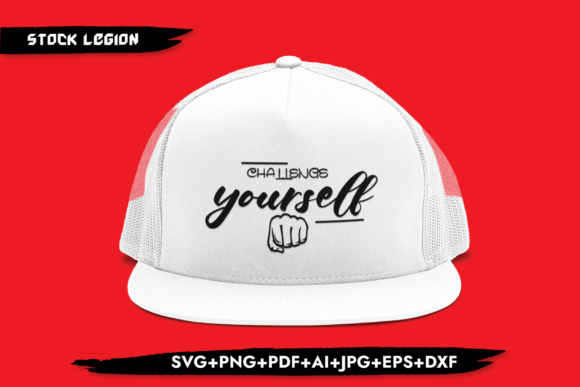
First impression? Challenge Yourself lands with quiet confidence — not loud or trendy, but grounded, intentional, and warmly motivational. The lettering balances clean geometry with subtle organic flow: rounded terminals, consistent stroke weight, and generous spacing. It reads as modern yet approachable — think small business branding for wellness coaches, educators, or mindful makers rather than corporate gyms or aggressive self-help brands. It’s feminine without being frilly, bold without shouting, and minimalist without feeling sterile. That versatility is rare — and commercially valuable.
This isn’t a decorative flourish. It’s a functional graphic design asset built for real-world use. The ZIP delivers six-inch square files at 300 DPI, optimized for both print and digital output. You’ll find crisp SVGs with smooth, closed paths (no stray nodes or overlapping vectors), transparent PNGs with clean alpha channels, and layered EPS options where relevant. All files are named clearly — no “design_01_v2_FINAL_really_final” chaos. That alone saves hours when prepping bundles or updating listings.
Where does Challenge Yourself shine across product categories?
- SVG products: Tested flawlessly on Cricut Design Space and Silhouette Studio — clean cut lines, no jagged edges, even at 2.5 inches tall. Ideal for vinyl decals on water bottles, tote bags, and laptop sleeves.
- Printable design: Scales beautifully for 8×10 wall art, planner quote pages, and affirmation cards. The 300 DPI resolution ensures sharpness even when printed on textured cardstock.
- Sublimation design: Works well on ceramic mugs and polyester apparel — holds contrast on light and medium substrates, though avoid very dark shirts unless you add a white underbase layer.
- Canva template: Drops seamlessly into editable Canva layouts. Pair it with Montserrat for clean headings or Playfair Display for elevated elegance — never competes with supporting text.
- Digital download bundles: Fits naturally alongside growth-themed clipart (lightbulbs, arrows, mountain silhouettes) or soft-color palettes in digital paper packs.
For visual storytelling and listing performance, Challenge Yourself strengthens perceived value fast. Used in a product mockup — say, on a matte-finish notebook or framed nursery print — it signals intentionality and care. In an Etsy thumbnail, its balanced composition and strong mid-tone contrast grab attention without relying on saturated color. When bundled with complementary designs (e.g., “Growth Mindset Bundle”), it anchors the collection’s emotional tone — making your shop feel curated, not cluttered.
It works best where clarity and calm confidence matter: printable wall art for home offices, affirmation stickers for bullet journals, tumbler wraps for coffee shops, Canva invitation templates for graduation or coaching launches, and social media graphics for Instagram carousels about habit-building or resilience.
But — and this is critical — test before you list. Challenge Yourself isn’t ideal for every use case. Avoid cramming it into tiny sticker sheets under 1 inch; fine spacing between letters can blur at micro-scales. Don’t place it directly over busy patterns or low-contrast backgrounds — it needs breathing room. And while the SVG cuts cleanly, always run a test cut on scrap material first: check for nested layers or hidden registration marks that might interfere with multi-layer projects.
Practical seller notes I applied before adding it to my shop:
- Ran it through three mockup generators — on white ceramic mug, kraft paper card, and linen pillow — to confirm legibility and tonal harmony.
- Previewed the thumbnail at 200×200 pixels in Etsy Seller Dashboard — still readable, still distinctive.
- Test-printed the PNG on matte and glossy photo paper to verify transparency edge integrity (no halos or fringing).
- Opened the SVG in Inkscape to inspect path direction and node count — clean, minimal, no redundant points.
- Confirmed commercial license terms explicitly cover resale of physical products (yes) and use in Canva templates sold to end users (yes, with proper attribution if required).
- Organized customer-facing files into labeled folders: /SVG, /PNG-Transparent, /Print-Ready-JPG — no guesswork for buyers.
Font pairing matters. I tested Challenge Yourself beside several common web-safe and marketplace-friendly typefaces: it harmonizes with Lora (serif), Inter (sans serif), Dancing Script (script), and Caveat (handwritten). It doesn’t compete — it complements. That makes it easy to integrate into broader brand identity systems for creative entrepreneurs building cohesive visual libraries.
In short: Challenge Yourself is a reliable, production-ready graphic design asset — not a novelty, not a placeholder. It supports small business branding with substance, adds polish to digital downloads without overcomplicating them, and performs consistently across crafts, printables, and merchandise. If you’re building a seasonal collection (back-to-school, New Year, mental wellness), launching a Canva template shop, or expanding your sublimation catalog, this is the kind of foundational design asset that quietly lifts your entire lineup.
Just remember: no file replaces testing. Run your own checks. Trust your mockups more than your preview pane. And always align the asset’s quiet strength with the story your customers are already choosing to believe — that growth is possible, one thoughtful step at a time.